Last Modified on September 30, 2026 by Dr. Tyler Meier
Sciatica vs Piriformis Syndrome: How to Tell the Difference
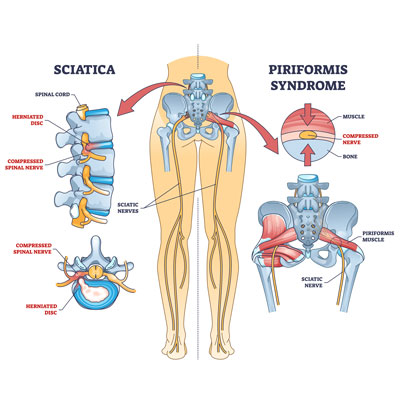
Sciatica and piriformis syndrome can both cause pain that starts around the buttock and travels down the leg. However, they are not the same problem.
The main difference in sciatica vs piriformis syndrome is where the sciatic nerve is being irritated. Sciatica is often related to irritation of a nerve root in the lower spine. Piriformis syndrome involves irritation of the sciatic nerve around the piriformis muscle in the buttock.
At CorePosture Chiropractic in Newport Beach, we evaluate sciatica symptoms to help identify factors that may be contributing to nerve irritation and determine whether conservative chiropractic care may be appropriate.
Sciatica vs piriformis syndrome: Quick comparison
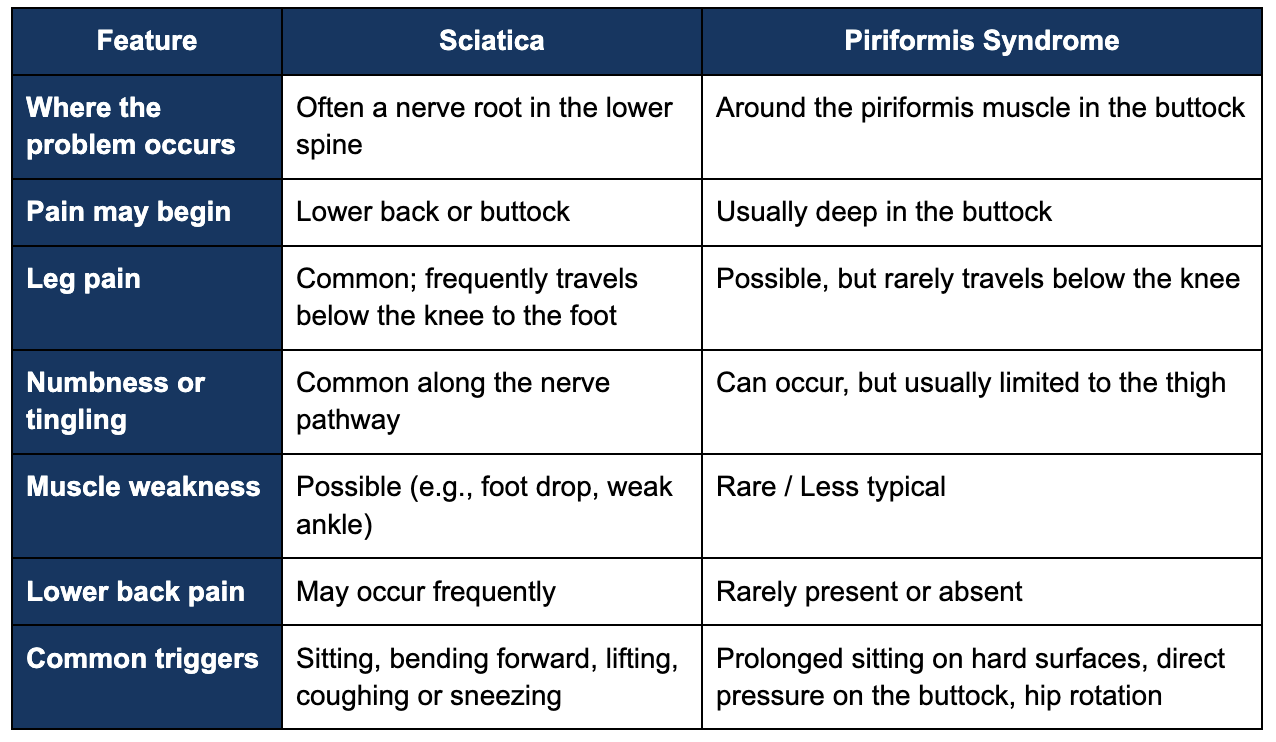
These patterns provide useful clues, but symptoms can overlap. A clinical evaluation may be needed to identify where the pain is coming from.
What sciatica actually means
Sciatica is not a disease by itself. It describes symptoms caused by irritation involving the sciatic nerve pathway.
The sciatic nerve is formed by nerve roots that leave the lower spine before traveling through the buttock and down the leg. When one of these nerve roots becomes irritated or compressed, pain may follow the path of the nerve.
Symptoms may include:
- Sharp, burning, or electric pain into the buttock and leg
- Tingling or numbness in the leg or foot
- Muscle weakness
- Pain that changes with certain positions or movements
Symptoms may also change over time. Prolonged sitting, changes in activity, lifting, and other mechanical factors are among the reasons sciatica can flare up.
Why piriformis syndrome can feel like sciatica
The piriformis is a small muscle deep in the buttock, close to the sciatic nerve. Irritation around this area may produce buttock pain that extends into the leg.
This can resemble sciatica caused by a problem in the lower spine. However, piriformis syndrome tends to involve more noticeable pain around the buttock, while sciatica related to a lumbar nerve root may be more likely to produce neurological symptoms farther down the leg.
The distinction is not always clear from symptoms alone. Buttock and leg pain can have several possible causes, so a tight or tender piriformis muscle does not automatically mean piriformis syndrome.
How sciatica and piriformis syndrome symptoms differ
Sciatica and piriformis syndrome can feel similar, but a few symptom patterns may help tell them apart.
Pain location and how it spreads. Sciatica may cause pain that starts in the lower back or buttock and spreads down the leg, sometimes reaching the foot. Piriformis syndrome usually causes more noticeable pain deep in the buttock, although it can also spread down the leg.
Numbness, tingling, and muscle weakness. Sciatica may cause numbness, tingling, or weakness in the leg or foot when a nerve root in the lower spine is affected. Muscle weakness and changes in reflexes are less common with piriformis syndrome.
Movements and positions that make pain worse. Sciatica may worsen with sitting, bending, lifting, coughing, or certain back movements. Piriformis syndrome may become more painful with prolonged sitting, pressure on the buttock, or certain hip movements.
These differences can provide useful clues, but symptoms alone cannot confirm the cause of leg pain.
What commonly causes sciatica?
Because sciatica describes a symptom pattern rather than one condition, several problems can cause it.
A herniated disc can irritate or compress a nearby nerve root when disc material moves beyond its normal position.
Spinal stenosis can reduce the space available for spinal nerves, sometimes leading to leg pain, numbness, or weakness.
Degenerative changes affecting the discs and joints can also reduce space around a nerve.
Other conditions can produce similar leg symptoms. Identifying the likely source matters because treatment for a spinal nerve problem may differ from treatment for pain coming from the hip or buttock.
How we evaluate sciatica at CorePosture
At CorePosture Chiropractic, we start by looking at your symptoms, health history, posture, and spinal function to better understand what may be contributing to your sciatica.
The evaluation may include:
Health history and symptoms. We discuss your health history, current symptoms, when the pain started, and how it is affecting your daily activities.
Postural assessment. We evaluate your posture and spinal alignment to identify structural or mechanical findings that may be relevant to your symptoms.
Orthopedic and neurological examination. We assess orthopedic and neurological findings to look for signs of nerve involvement and better understand how your body is functioning.
Full spine X-rays when necessary. When appropriate, digital X-rays may be used to evaluate spinal alignment, curvature, bone structure, and other structural findings.
We consider these findings together to determine whether conservative chiropractic care may be appropriate and to develop a personalized care plan.
Treatment options for sciatica
Treatment depends on the cause, severity of symptoms, neurological findings, and how much the condition affects daily activities.
Activity and rehabilitation
Complete bed rest is generally not the goal. Gentle movement may be appropriate when it does not significantly worsen symptoms.
Rehabilitation may focus on mobility, strength, movement control, and a gradual return to normal activities. There is no single exercise routine that is right for every case of sciatica.
Chiropractic care
Chiropractic care may be considered as part of a conservative approach for some people with sciatica. The appropriate approach depends on the suspected cause, neurological findings, severity of symptoms, and response to care.
When sciatica symptoms need urgent medical attention
Most sciatica symptoms do not require emergency care. Seek urgent medical evaluation for:
- New loss of bladder or bowel control
- Numbness around the groin or inner thighs
- Rapidly worsening leg weakness
- Significant weakness in both legs
- Severe neurological symptoms after major trauma
These signs may indicate serious nerve compression and should not wait for a routine chiropractic appointment.
Sciatica care at CorePosture Chiropractic
At CorePosture Chiropractic in Newport Beach, Dr. Tyler Meier provide individualized care based on each patient’s examination findings and needs.
When appropriate, care for sciatica may include chiropractic adjustments, customized postural exercises, or computerized spinal decompression. If symptoms indicate that further medical evaluation is needed, that should take priority.
If sciatica continues to affect your ability to sit, walk, work, or stay active, contact us to schedule an evaluation.
Frequently asked questions
Is piriformis syndrome the same as sciatica?
No. Sciatica involves symptoms along the sciatic nerve pathway and is often related to nerve root irritation in the lower spine. Piriformis syndrome involves irritation of the sciatic nerve around the piriformis muscle.
Does sciatica always start in the lower back?
No. Sciatica can be felt mainly in the buttock or leg even when lower back pain is mild or absent.
Can sciatica cause numbness and muscle weakness?
Yes. Nerve root involvement can cause numbness, tingling, or weakness in the leg or foot. Progressive weakness should be medically evaluated.
When should you see a chiropractor for sciatica?
A chiropractic evaluation may be appropriate when sciatica persists or interferes with normal activities and there are no urgent neurological warning signs. Treatment should depend on the underlying cause and examination findings.

Dr. Tyler Meier is a board-certified, licensed chiropractor and founder of CorePosture Chiropractic in Newport Beach, CA