Last Modified on October 21, 2026 by Dr. Tyler Meier
Loss of Cervical Lordosis: Understanding Changes in Your Neck Curve
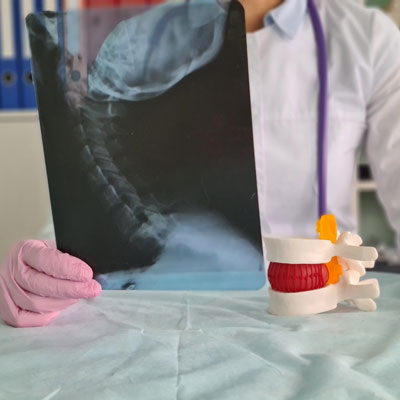
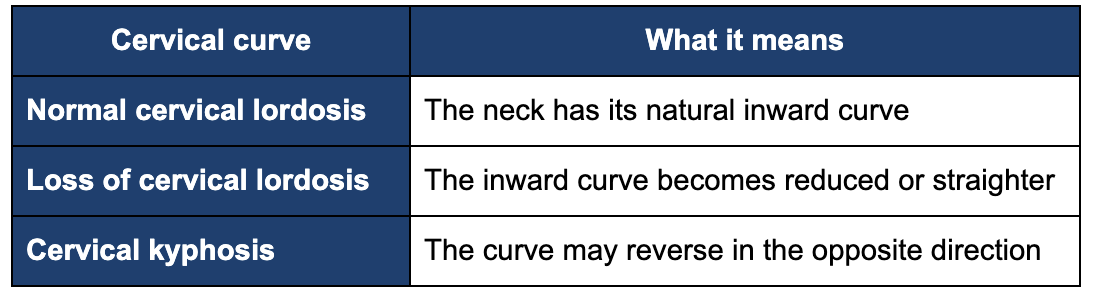
Loss of cervical lordosis means the natural inward curve of your neck has become reduced or straighter than expected. You may see this described as “straightening of the cervical lordosis” or “straight neck” on an X-ray report.
This finding does not always mean something is wrong. Some people have no symptoms, while others may experience neck pain, stiffness, headaches, or changes in movement.
At CorePosture Chiropractic, we look at your symptoms, posture, movement, and spinal alignment together to understand what changes in your cervical curve may mean for you.
What is loss of cervical lordosis?
Your cervical spine is the part of your spine that makes up your neck. When viewed from the side, it normally has a gentle inward curve called cervical lordosis.
Loss of cervical lordosis occurs when this curve becomes reduced and the neck appears straighter than expected. You may also hear this described as straight neck or military neck.
The shape of your cervical spine is only one part of your overall spinal health. An X-ray finding alone cannot tell us whether you have pain or whether treatment is needed.
Loss of cervical lordosis vs cervical kyphosis
Loss of cervical lordosis and cervical kyphosis are related, but they are not the same.
What causes loss of cervical lordosis?
There is no single cause of loss of cervical lordosis. Posture, muscle tension, injuries, aging, and structural changes may all play a role.
Poor posture and tech neck
Long periods looking down at a phone or working with a screen below eye level can keep your head in a forward position and increase strain on your neck.
However, poor posture does not automatically mean your cervical curve has permanently changed. Tech neck and forward head posture can also cause discomfort without necessarily causing loss of cervical lordosis.
Muscle tension and neck injuries
Tight or guarded muscles can affect how you hold and move your neck. This may occur after whiplash, a fall, or another neck injury.
If a change in cervical lordosis appears after an injury, the injury itself should be considered when evaluating the finding.
Spinal degeneration and aging
The discs and joints in your neck naturally change with age. Changes in disc height, joint movement, and bone structure may affect cervical alignment.
These changes do not always cause pain, which is why imaging should be considered alongside your symptoms.
Other structural factors
Previous spinal surgery, differences in spinal development, and certain structural conditions may also affect the cervical curve. These cases require individual evaluation rather than assuming posture is responsible.
Common symptoms associated with loss of cervical lordosis
Some people with loss of cervical lordosis have no symptoms.
When symptoms are present, they may involve the muscles, joints, discs, or nerves of the cervical spine. Possible symptoms include:
- Neck pain or stiffness
- Reduced neck movement
- Shoulder or upper back discomfort
- Headaches
- Muscle fatigue
- Tingling or numbness in an arm or hand
- Arm or hand weakness
It is important not to assume that every symptom comes directly from a reduced cervical curve. For example, neck pain, headaches, and dizziness can occur together for several reasons.
How is loss of cervical lordosis diagnosed?
Understanding your cervical curve involves more than looking at one image. Your symptoms, history, posture, and neck function also matter.
Physical and postural examination
An evaluation may include your health and injury history, posture, neck movement, pain pattern, and daily activities.
If you have tingling, numbness, weakness, or pain traveling into an arm, neurological testing may also be appropriate.
What X-rays can show about your cervical curve
An X-ray taken from the side can show the shape and alignment of your cervical spine. It can help identify whether the normal curve is present, reduced, straightened, or reversed.
At CorePosture, digital X-rays can be part of corrective chiropractic evaluation when clinically appropriate. Imaging is considered together with your symptoms and examination findings rather than used alone to determine treatment.
Treatment options for loss of cervical lordosis
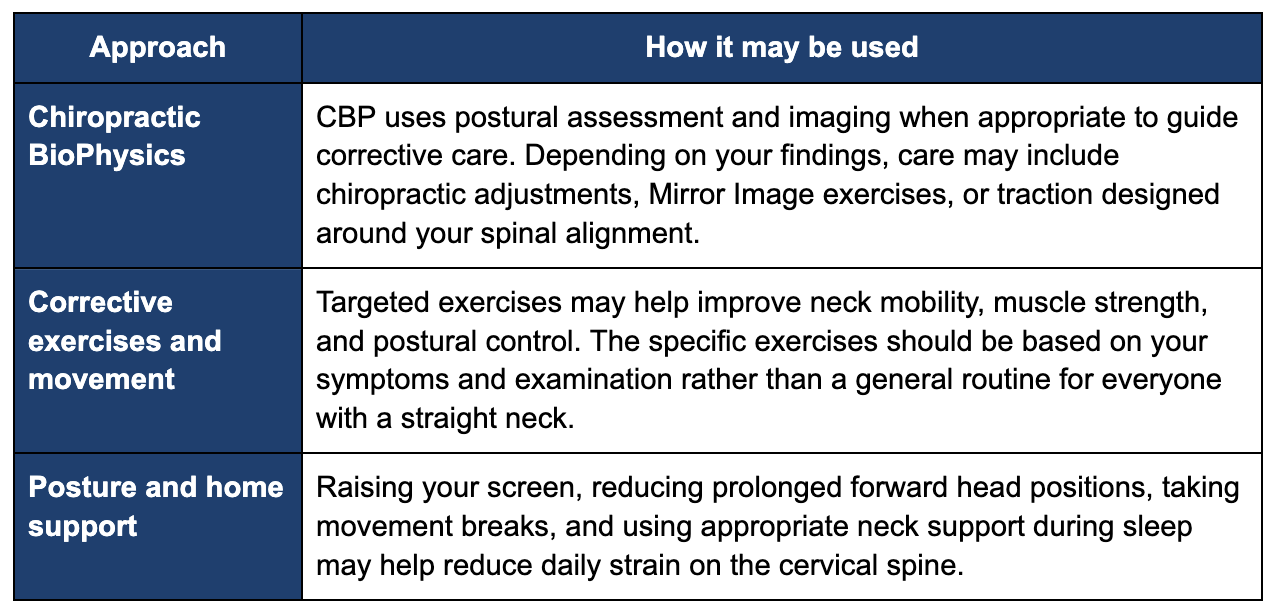
Treatment for loss of cervical lordosis depends on the cause of the curve change, your symptoms, and your examination findings. There is no single approach that is right for everyone.
When should you have your neck checked?
Consider having your neck evaluated if you have persistent neck pain, stiffness, reduced movement, recurring headaches with neck symptoms, or symptoms following an accident or whiplash injury.
You should also seek evaluation if you develop tingling, numbness, weakness, or pain that travels from your neck into an arm.
More concerning symptoms, such as progressive weakness, difficulty walking, loss of coordination, or bowel or bladder changes, require prompt medical attention.
Understanding your neck curve is the first step
Loss of cervical lordosis describes a change in your cervical curve, but it does not tell the whole story. Your symptoms, posture, movement, injury history, and examination findings help determine whether the change is meaningful and what care may be appropriate.
At CorePosture Chiropractic in Newport Beach, we use a corrective approach that considers posture and spinal alignment together. When appropriate, care may include digital X-rays, Chiropractic BioPhysics principles, corrective exercises, and chiropractic care based on your individual findings.
If you have persistent neck symptoms or questions about a change seen on an X-ray, you can contact us to discuss the appropriate next step.
Frequently asked questions about loss of cervical lordosis
Can loss of cervical lordosis be reversed?
It may improve in some cases, but it depends on the cause and type of curve change. Results vary from person to person.
Is loss of cervical lordosis the same as straight neck?
Straight neck commonly describes a reduced or straightened cervical lordosis. The exact meaning depends on your imaging and examination findings.
Can loss of cervical lordosis cause headaches?
Neck problems can be associated with headaches, but a reduced cervical curve is not always the cause. Headaches can have many different sources.
What is the best sleeping position for loss of cervical lordosis?
Back or side sleeping may be comfortable when your pillow supports your neck in a neutral position. There is no single best position for everyone.
How long does it take to correct loss of cervical lordosis?
There is no standard timeline. It depends on the cause, severity, symptoms, and your individual response to care.

Dr. Tyler Meier is a board-certified, licensed chiropractor and founder of CorePosture Chiropractic in Newport Beach, CA