
Last Modified on September 2, 2026 by Dr. Tyler Meier
What Causes Sciatica to Flare Up? 7 Common Triggers

Sciatica can flare up again even after previous symptoms have started to improve. Sitting for too long, lifting heavy objects, changing your activity level, or certain daily habits can irritate an already sensitive nerve and cause the pain to return.
At CorePosture Chiropractic, we often see patients who do not understand why their sciatica suddenly worsens even though they have not experienced a new injury.
So, what causes sciatica to flare up? Below are seven common triggers, the underlying factors that may be contributing to them, and ways to reduce the risk of recurring flare-ups.
Why sciatica flares in the first place
The sciatic nerve is the largest nerve in your body. The nerve begins in the lower back, forming from several nerve roots in the lumbar spine, then travels through the buttock and down the back of each leg.
Sciatica is not a diagnosis on its own. It describes what you feel when the sciatic nerve becomes compressed or irritated somewhere along that path. Pressure at a nerve root, swelling in the surrounding tissue, or both.
That distinction matters for flare-ups. The underlying cause, a disc or a narrowed canal, changes slowly over months. What changes fast is inflammation and pressure. A flare-up is almost always a spike in one of those two, not sudden new damage.
Sciatica symptoms follow the path of the sciatic nerve. Burning pain that travels from the lower back into the buttock and leg, numbness in the foot, a tingle down the calf, or weakness when you push off. Mild sciatica may be a dull ache. Severe pain and sharp leg pain can stop you walking. Sciatic pain does not always follow the same shape twice.
7 common causes of sciatica flare ups
1. Prolonged sitting
Sitting can increase pressure on the lumbar discs and reduce the activity of the muscles that support your spine. Long periods at a desk, a long flight, or a drive up the 405 can all trigger symptoms.
This is one of the triggers I see most often. If your sciatica pain tends to get worse after you have been sitting for a long time, prolonged sitting may be a factor.
2. Heavy lifting and bad mechanics
Lifting heavy loads with a rounded lower back drives pressure toward the back of the disc, exactly where the nerve sits. It does not take a gym. A suitcase, a toddler, or a bag of soil will do it.
The load matters less than the shape you make while you lift heavy things.
3. Poor posture
Poor posture shifts where your spine carries weight. A forward head and a flattened lower curve move load toward the discs and hold it there all day.
Posture is a slow trigger rather than a sudden one, which is why it gets missed. It sets up the sciatica, then a small movement finishes the job.
4. A sudden jump in activity
Weekend surfing after a month off, a new gym programme, a long hike. A big change in load can irritate the sciatic nerve within a day.
I am not telling you to stop exercising. I am telling you to build up rather than jump.
5. Twisting and bending together
Twisting while bent forward is the single riskiest movement for a lumbar disc. Reaching into the back seat, unloading a dishwasher, pulling a golf bag out of a boot.
Any of these can cause pain within minutes.
6. Stress and poor sleep
Stress raises muscle tension through the low back and hips, and short sleep lowers your tolerance for pain. Neither creates nerve pressure. Both make an irritated nerve feel considerably worse.
Patients often notice sciatica acts up during a hard week at work. That is real, not imagined.
7. Coughing and sneezing
A cough or a sneeze briefly spikes the pressure inside your trunk, and that pressure reaches the disc. When the nerve is already sensitive, the result is a short burst of pain down the leg.
This one tells me something useful. If coughing reproduces your leg symptoms, that points toward a disc rather than a muscle, so mention it at your appointment.
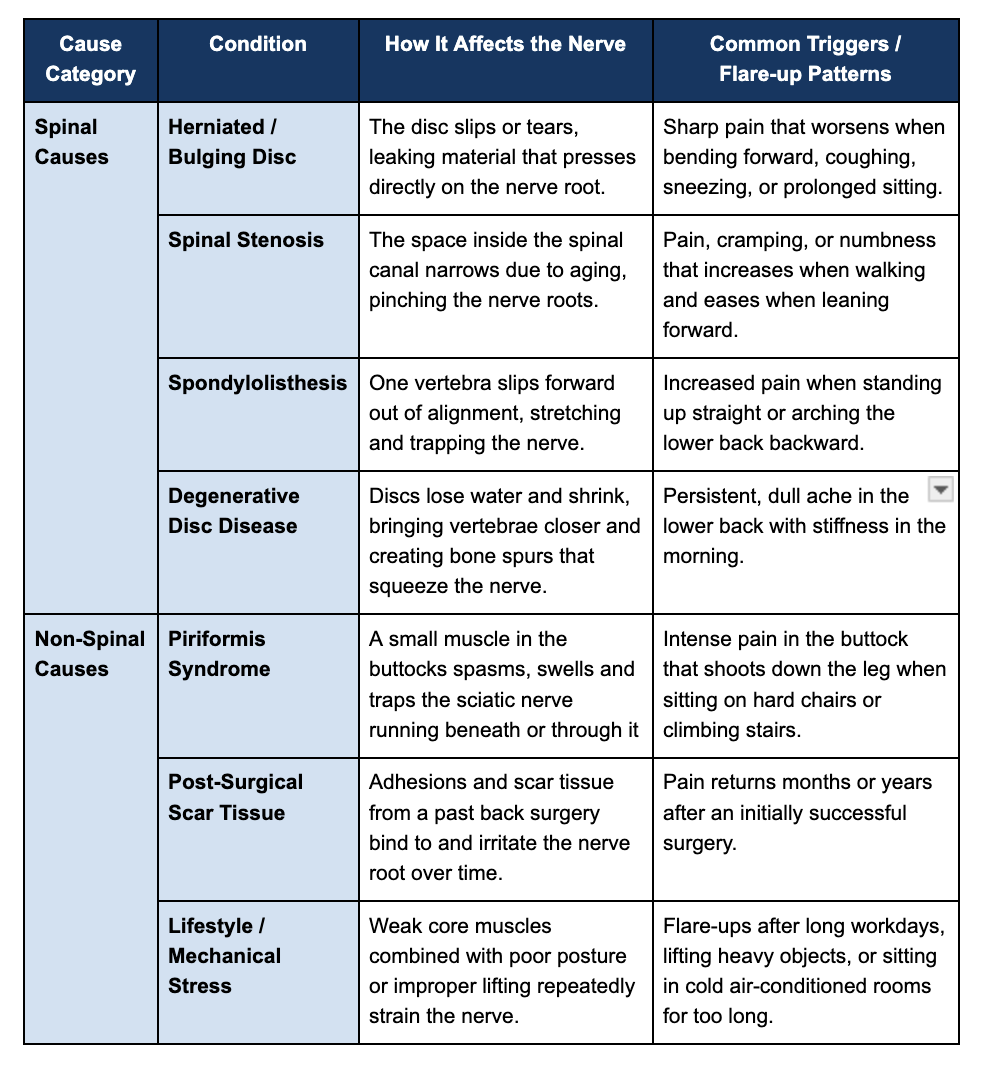
What sits behind recurring sciatica
A trigger can make sciatica symptoms worse, but it may not be the underlying cause. Several conditions can irritate or put pressure on the nerve and make flare ups more likely.
How to prevent sciatica flare-ups
Preventing sciatica is unglamorous work and it succeeds more often than people expect.
- Break up prolonged sitting every 30 minutes, even for one minute of standing
- Hinge at the hips and keep the load close when you lift
- Build core and glute strength, since strong hips reduce what the spine carries
- Keep moving when symptoms spike. Bed rest beyond a day or two slows recovery
- Address posture rather than only treating pain, because posture is the setup
- Track your own pattern. Note what you were doing beforehand, how far the pain travelled, and how long it lasted
A chiropractor for sciatica can help by reducing nerve irritation and restoring spinal movement. In our practice I combine adjustments with traction and home exercise, because the treatment plan that works is the one that changes the mechanics rather than only calming the symptoms.
When symptoms last longer than six weeks
Most cases of sciatica improve within several weeks. However, when symptoms last longer than six weeks, keep returning, or continue to get worse, it may be time to look more closely at the underlying cause.
Persistent sciatica can be related to ongoing irritation or compression of a nerve in the lower back. An evaluation can help determine what may be contributing to the symptoms and which treatment options are appropriate.
Some symptoms require urgent medical attention. Seek medical care right away if you develop loss of bladder or bowel control, numbness around the groin or inner thighs, worsening leg weakness, or sciatica symptoms in both legs.
Getting to the cause instead of chasing symptoms
Knowing what triggers a sciatica flare up can help you avoid activities that make symptoms worse. But when the pain keeps returning, managing triggers alone may not be enough. The next step is understanding why the sciatic nerve continues to become irritated.
At CorePosture Chiropractic, we evaluate your symptoms, posture, spinal alignment, and other clinical findings before recommending care. Digital X-rays may also be used when appropriate to better understand structural changes that could be contributing to recurring symptoms.
Depending on what we find, care may include chiropractic adjustments, Chiropractic BioPhysics, spinal rehabilitation, posture specific exercises, or spinal decompression. The goal is to build a treatment plan around your individual findings rather than treating every case of sciatica the same way.
If sciatica keeps returning or is interfering with your daily activities, call us to schedule an evaluation.
Frequently asked questions
How long does a sciatica flare-up last?
Most episodes settle within a few days to two weeks once the swelling calms. Flares that drag on usually point to ongoing compression rather than passing swelling.
Can stress alone cause sciatica to flare up?
Stress does not compress a nerve, but it raises muscle tension and lowers pain tolerance, which can make an existing problem flare. Sleep and stress are worth addressing alongside the mechanical causes.
Should I rest or move during a flare?
Keep moving gently. A day of relative rest is fine, but prolonged bed rest can weaken the muscles that support your spine and may make it harder to return to normal activity.
Does walking help sciatica or worsen it?
Short, frequent walks usually help by keeping the nerve mobile and reducing stiffness. If walking clearly worsens leg symptoms, stop and get assessed rather than pushing through.

Dr. Tyler Meier is a board-certified, licensed chiropractor and founder of CorePosture Chiropractic in Newport Beach, CA