Last Modified on September 2, 2026 by Dr. Tyler Meier
Morning Lower Back Pain: Causes, Symptoms and Relief

Waking up with lower back pain is a common problem, and many cases are linked to mechanical factors that can be addressed. At CorePosture Chiropractic in Newport Beach, we look at how posture, spinal alignment, and daily habits may contribute to the problem. The important part is knowing which pattern you have, because one may need a change in your sleep setup while another may need medical evaluation.
Why your back hurts when you wake up
Several changes happen while you sleep that can make lower back pain feel worse in the morning.
Your spinal discs take in more fluid while you are lying down. This is a normal process, but the increased fluid can make an already sensitive disc feel stiffer or more uncomfortable when you first wake up.
At the same time, your spine and back muscles stay relatively still for several hours. If an area is already tight or irritated, that lack of movement can make stiffness more noticeable when you get out of bed.
Your sleeping position can add to the problem. Spending hours with your lower back twisted or poorly supported may place extra stress on the muscles and joints around the spine.
A common pattern of mechanical morning pain is stiffness that improves after you start moving. If your lower back feels better within about 20 or 30 minutes, your sleeping position, mattress, muscles, or spinal joints may be contributing to the problem.
Common causes of lower back pain in the morning
Poor sleeping posture. Sleeping on your stomach flattens the natural curve of your spine and rotates your neck for hours. It is the position most likely to leave you sore.
An unsupportive mattress. A bed that has lost its support lets your hips sink, putting strain on the lower back all night. Most last seven to ten years, and the sag is gradual enough that you stop noticing it.
Muscle strain. Yesterday’s lifting or a hard workout shows up as lower back pain this morning. It usually peaks a day after the activity and fades within a week.
Degenerative disc disease. As the spinal discs between the vertebrae thin with age, the joints take more load and the wear and tear shows up as morning stiffness that improves with movement.
Arthritis in the spine. Facet joint arthritis produces a similar pattern, often with pain that eases once you are standing or walking.
Pregnancy or extra weight in the lower abdomen. Additional front loading pulls the lumbar spine forward, and the muscles of your back work all night to compensate. That is a common source of lower back pain in pregnancy.
How your mattress and pillow setup affects your spine
Getting this right solves more cases of lower back pain than any exercise I can give you.
Firmness. A medium firm suits most people. Too soft and your hips drop out of line. Too firm and your shoulders and hips carry all the pressure points instead of sharing the load.
Mattress age. If yours is over eight years old, or you sleep better in hotels, that is likely your answer.
Pillow height. Your pillow should keep your head level with your spine, not propped up or dropped down. One too many pillows tilts the whole chain.
Side sleeping. Try a pillow between your knees. Placing a pillow between the knees helps even out your hips and maintain proper spinal alignment through the night.
On your back. If you sleep on your back, try placing a pillow underneath your knees. It reduces the arch in your lower spine and takes pressure off the spinal nerves.
Stomach sleeping. If you cannot break the habit, a thin cushion under your hips reduces that load considerably.
A morning routine that reduces lower back pain
Do not go from lying flat to standing in one movement. Give your spine five minutes.
- While still lying down, pull one knee gently toward your chest, then the other. Ten slow repetitions each.
- Roll onto your side and let your knees drop together, then rotate gently the other way.
- Roll to your side and push up with your arm rather than sitting straight up from flat.
- Once standing, walk for two minutes before you do anything else.
- Take a warm shower if stiffness lingers, since heat helps the muscles release.
When morning stiffness points to something else
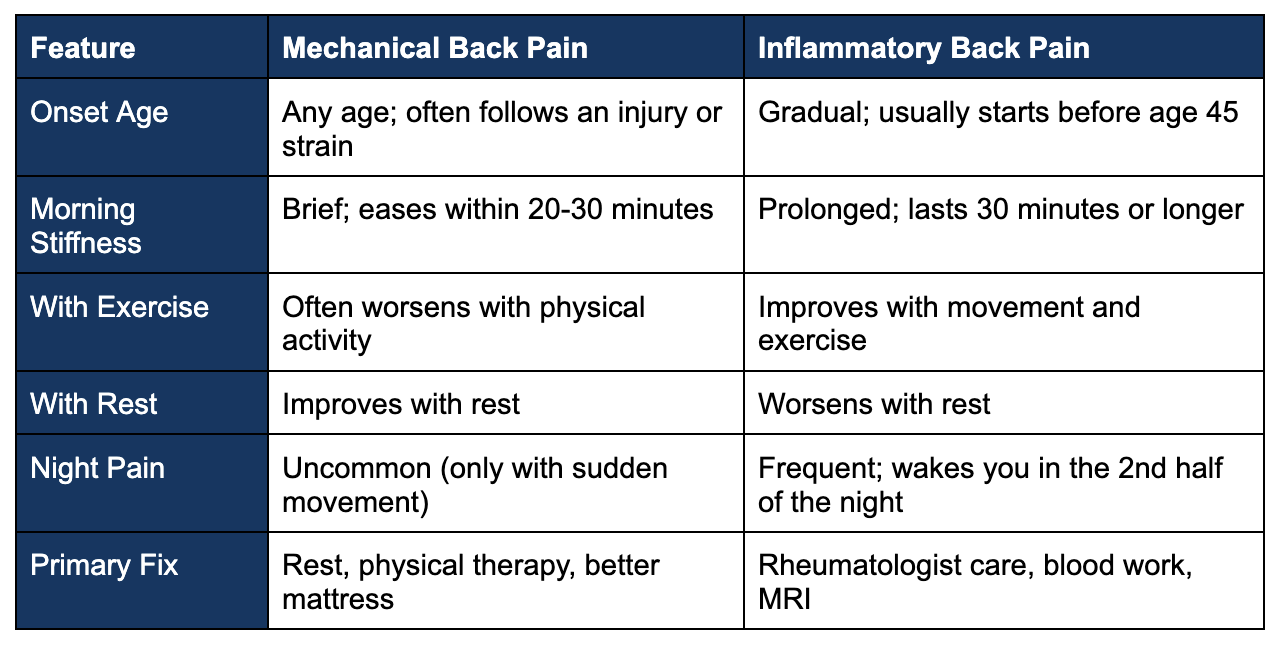
Most articles overlook a crucial distinction: lower back pain generally falls into two categories that behave in completely opposite ways.
- Mechanical back pain: Caused by muscle strain, disc issues, or physical wear and tear.
- Inflammatory back pain: Related to inflammation in the spine. The pain often improves with movement and may get worse with rest.
When to see a doctor for morning lower back pain
If your symptoms align with Inflammatory Back Pain, a new mattress won’t solve the problem. This pattern requires specialized evaluation by a rheumatologist, including inflammatory blood markers and targeted imaging.
Seek immediate medical evaluation if your back pain is accompanied by:
- Pain lasts longer than a few weeks without improvement.
- Numbness, tingling, or weakness radiating down a leg.
- Unexplained weight loss or persistent fever.
- Sudden loss of bowel or bladder control.
Conclusion
If morning lower back pain keeps returning despite changes to your mattress, pillow, and sleeping position, it may be time to look beyond your sleep setup. How you sit, move, and load your spine during the day can also contribute to the stiffness you notice the next morning.
At CorePosture Chiropractic, we evaluate posture and spinal alignment to better understand what may be contributing to persistent symptoms. Digital X-rays may also be used when clinically appropriate rather than relying on symptoms alone.
If morning pain is becoming a regular part of your day or is affecting how you move and function, contact us to schedule an evaluation and determine an appropriate next step.
Frequently asked questions
Why is my lower back pain worse in the morning and better later?
Overnight fluid shifts into the discs of your spine and hours without movement both raise pain and stiffness by morning. If it clears within half an hour of moving, that pattern is mechanical rather than inflammatory.
Can a mattress really cause lower back pain?
Yes. A sagging mattress lets the hips drop below the shoulders for seven hours a night, which loads the spine continuously. Replacing one that is past eight years old resolves a surprising number of cases.
What is the best sleeping position for lower back pain?
Side sleeping with a cushion between the knees, or back sleeping with one under the knees. Both keep your spine closer to neutral than stomach sleeping does.
Should I stretch before getting out of bed?
Yes, gently. A few knee to chest movements and a slow roll to your side reduce the jolt of standing up cold. Sleeping with a pillow supporting your knees the night before helps too.
Do nonsteroidal anti-inflammatory drugs help morning back pain?
They can reduce inflammation and take the edge off, though they treat the symptom rather than the cause. Check with your doctor before regular use.

Dr. Tyler Meier is a board-certified, licensed chiropractor and founder of CorePosture Chiropractic in Newport Beach, CA