
Last Modified on May 6, 2026 by Dr. Tyler Meier
You Stretch Every Day – So Why Isn’t Your Posture Improving?

You roll out your mat every morning. You do the hip flexor stretch, the chest opener, the shoulder rolls. Maybe you’ve added yoga. Maybe you’ve watched every “fix your posture” video on YouTube. And yet – why isn’t your posture improving?
Here’s the uncomfortable truth most fitness content won’t tell you: stretching is not a posture fix. It’s a symptom reliever. And if you’ve been at this for months with little to show for it, the problem likely isn’t your effort – it’s your approach.
Let’s break down exactly what’s happening and what actually works.
The Hard Truth: Stretching Alone Won’t Fix Your Posture
Stretching feels productive. It relieves tension, improves flexibility, and gives you a temporary sense of relief. But posture problems are rarely just tight muscles.
Stretching = symptom relief. Posture = a structural and neurological issue.
When your spine has adapted to poor alignment over months or years, no amount of hamstring stretches will undo that. The structure itself has changed. The nervous system has accepted the bad position as “normal.” You’re treating the output, not the source.
5 Reasons Your Posture Isn’t Improving
1. You’re Treating Muscles, Not Your Spine
Muscles attach to bones. If the bones – specifically the vertebrae – are misaligned, the muscles pulling on them will always return to that misaligned position. It’s like straightening a bent nail by painting over it.
Structural alignment is the foundation. Without it, muscle work is temporary. This is where a clinical approach to posture correction becomes essential, not optional.
2. Your Body Has Adapted to Poor Posture
Your nervous system is incredibly adaptive and that’s the problem. After months of slouching, hunching, or forward head posture, your brain has recalibrated its baseline. It now interprets bad posture as normal and good posture as uncomfortable.
This neuro-habit loop is why sitting up straight feels like effort. You’re not weak – you’re fighting a deeply ingrained pattern. Breaking it requires more than awareness; it requires systematic retraining.
3. Sitting All Day Cancels Out Your Efforts
Ten minutes of morning stretching versus eight hours at a desk? The desk wins every time.
Office and remote workers are among the highest-risk groups for postural breakdown. Prolonged sitting shortens hip flexors, loads the lower back, rounds the shoulders, and pushes the head forward. Even if your posture correction exercises are working, they can’t outpace what hours of static sitting undoes daily.
The fix isn’t just movement – it’s addressing the cumulative structural load your lifestyle creates.
4. You’re Strengthening the Wrong Areas
Many people focus on stretching the chest and strengthening the upper back. That’s a start – but posture imbalance is full-body. A weak core destabilizes the lumbar spine. Tight hip flexors tip the pelvis forward. Weak deep neck flexors drop the chin.
If your plan targets only one area, you’re correcting one thread while the rest of the fabric unravels. Posture correction exercises not working often comes down to this: the right goal, the wrong map.
5. Your Posture Problem Is Structural, Not Temporary
This is the one most people don’t want to hear. If you’ve had bad posture for years, your spine has likely undergone long-term structural adaptation. Ligaments have been remodeled. Spinal curves have changed. Discs are unevenly loaded.
At this stage, asking stretching to fix your posture is like asking ibuprofen to fix a fracture. The symptom may be quiet – but the structure remains. This is why bad posture isn’t getting better despite consistent effort for so many people.
What Actually Works (Backed by Chiropractic Science)
Posture correction that lasts requires a research-backed spinal correction approach — not just exercises.
One of the most evidence-based frameworks available is Chiropractic BioPhysics (CBP) – a clinical method that uses mirror-image adjustments, traction, and rehabilitation to restore normal spinal curvature. A peer-reviewed study by Dr. Deed Harrison, published in the Journal of Manipulative and Physiological Therapeutics, demonstrated measurable, sustained improvements in spinal alignment using CBP protocols.
Here’s how a structural approach differs from stretching alone:
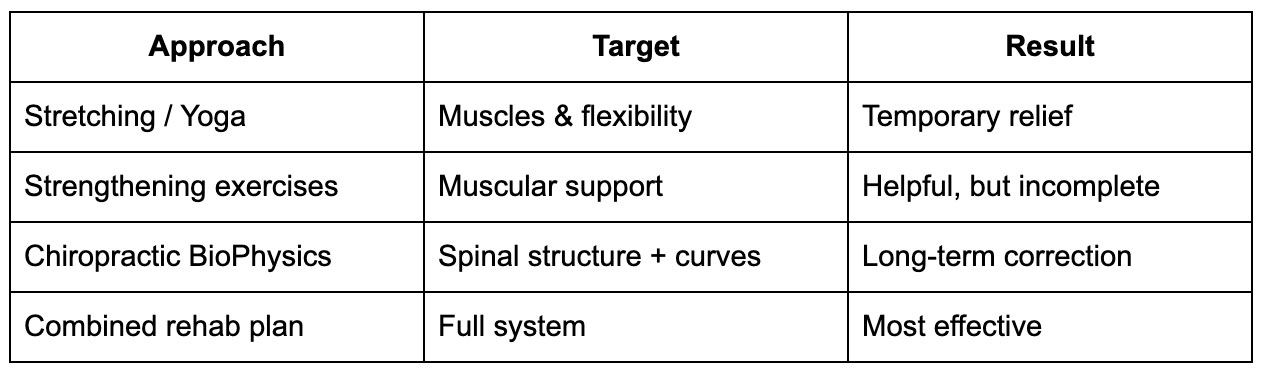
The goal isn’t to feel better for a few hours. It’s to fix posture permanently by addressing what’s actually driving it.
Signs Your Posture Problem Needs Professional Help
You’ve tried. You’ve been consistent. And still your posture isn’t improving. Here’s when to stop DIY-ing and get a professional evaluation:
- Pain returns quickly after stretching or exercise – within hours, not days
- Uneven shoulders – one visibly higher or more forward than the other
- Forward head posture – ears sitting in front of your shoulders in the mirror
- Chronic stiffness – especially in the neck, upper back, or lower back that won’t fully release
These aren’t signs of weakness or laziness. They’re signs of a structural issue that needs a clinical eye.
Can You Fix Posture on Your Own?
Honestly – it depends on how far the problem has progressed.
- Mild postural habits (less than 1–2 years, no pain): Yes. Consistent targeted exercises, ergonomic adjustments, and movement breaks can work.
- Structural or chronic cases: Unlikely without professional guidance. Once the spine has physically adapted to misalignment, self-directed work hits a ceiling.
This isn’t about selling you on a solution – it’s about being straight with you. Many patients who come to us have spent years on YouTube routines before realizing they needed a structural assessment first.
Fix the Root, Not the Symptoms
Stretching isn’t wrong. It’s just incomplete.
If you’ve been wondering why your posture isn’t improving despite doing everything right, the answer usually lives in your spine’s structure, not your discipline. You can’t stretch your way out of a structural problem, and you can’t strengthen your way out of a neurological habit without first resetting the baseline.
The most effective path forward combines professional spinal correction with targeted rehab and smarter daily habits.
At CorePosture Chiropractic, Dr. Tyler Meier and our team specialize in exactly this. As your trusted Chiropractor Newport Beach, we use evidence-based structural assessment to find out why your posture isn’t getting better and build a plan to actually fix it.
CorePosture Chiropractic at Newport Beach, CA 92660. Book a Posture Assessment – or simply Get Your Spine Checked and find out what stretching alone can’t tell you.
Note: This article is educational and does not substitute for personalized medical advice. If you’re experiencing pain, consult a qualified healthcare provider.

Dr. Tyler Meier is a board-certified, licensed chiropractor and founder of CorePosture Chiropractic in Newport Beach, CA