Last Modified on March 4, 2026 by Dr. Tyler Meier
Learning how to check for scoliosis at home can help you spot early warning signs and decide when professional evaluation is needed. At CorePosture Chiropractic in Newport Beach, we encourage parents and adults to do these simple checks, especially during growth spurts when scoliosis is most likely to appear or progress.
This guide walks you through exactly what to look for, how to perform basic screening tests, and just as importantly – what home checks can and cannot tell you.
Is It Really Possible to Check for Scoliosis at Home?
Let’s set expectations right from the start.
What home screening CAN help identify:
- Visible postural asymmetries
- Early warning signs that warrant professional evaluation
- Changes over time that suggest progression
What home checks CANNOT diagnose:
- The exact degree of spinal curvature (Cobb angle)
- Whether the curve is structural or functional
- The type or severity of scoliosis
- Whether treatment is needed
Why early visual signs matter: Research by Dr. Lonstein, published in The Journal of Bone and Joint Surgery, showed that early detection of scoliosis during growth years significantly improves treatment outcomes. The earlier a curve is identified, the more options exist for non-surgical correction.
Importance of professional confirmation: Home checks are screening tools, not diagnostic tools. If you notice any of the signs we’re about to cover, schedule an evaluation with a qualified provider who can take X-rays and measure curvature accurately.
Step-by-Step: How to Check for Scoliosis at Home
Step 1: Forward Bend Test (Adam’s Test)
This is the most important home screening test for scoliosis. It’s the same test school nurses use during scoliosis screenings.
How to perform it correctly:
- Have the person stand with feet together
- Ask them to bend forward at the waist with arms hanging down
- Keep knees straight and bend until the back is parallel to the floor
- Stand behind them and look down their spine
What to look for:
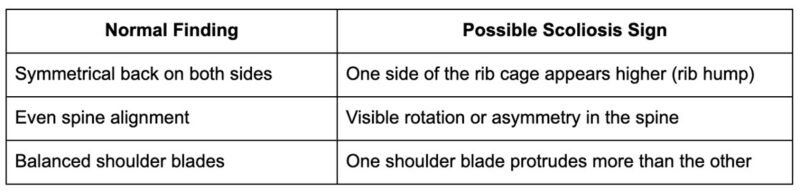
Best viewing conditions: Good lighting from above or the side makes asymmetries much easier to spot. A completely symmetrical back is what you’re hoping to see.
Step 2: Standing Straight Posture Check
Shoulder height comparison: Look straight at them from the front. Are both shoulders at exactly the same height, or does one sit noticeably higher? Take a photo if it helps you compare.
Hip and waistline symmetry: Check whether the spaces between their arms and waist look equal on both sides. Uneven “waist triangles” can indicate pelvic tilt or spinal curvature.
Head alignment over pelvis: From the front and side, the head should sit centered over the pelvis. If it’s shifted to one side or tilted, that’s worth noting.
Step 3: Clothes Fit and Visual Symmetry Check
Sometimes clothing reveals what’s harder to see on bare skin.
What to watch for:
- Shirt hems that consistently hang longer on one side
- Pant legs that appear uneven in length
- Waistbands that sit crooked despite being properly fastened
- Bra straps that slip off one shoulder repeatedly
- Belt buckles that shift to one side
- Jacket shoulders that don’t sit evenly
These aren’t diagnostic on their own, but they’re practical clues that something might be asymmetrical.
Step 4: Eyes, Ears, and Head Position Check
Head tilt or rotation: Does their head tilt to one side? Does it appear slightly rotated even when they’re trying to look straight ahead?
Ear height comparison: Are both ears at the same height, or does one sit noticeably lower? While minor differences are normal, significant asymmetry can indicate compensatory posture from scoliosis below.
Signs of compensatory posture: Sometimes the body tilts the head to keep the eyes level even when the spine curves below. This compensation can mask the underlying curve during casual observation.
Step 5: Walking and Movement Observation
Arm swing symmetry: Do both arms swing evenly, or does one stay closer to the body? Uneven arm swing can indicate trunk rotation from scoliosis.
Pelvic shift or uneven stride: Does their pelvis shift side to side excessively? Does one leg appear to travel differently than the other during walking?
Balance changes: People with scoliosis sometimes develop subtle balance issues or appear to lean slightly to one side while walking.
Step 6: Family History and Growth Changes
Context matters when evaluating scoliosis risk.
Family history factors:
- Known scoliosis in parents or siblings significantly increases risk
- If anyone in the family wore a brace or had scoliosis surgery, monitoring is especially important
Rapid growth periods: Scoliosis often appears or worsens during growth spurts – typically ages 10-15 for girls and 12-16 for boys.
Worsening asymmetry over time: If you’ve been noticing gradual changes – shoulders becoming more uneven, or a rib hump that seems more pronounced – that progression is significant and warrants evaluation.
How Chiropractic BioPhysics and ScoliBrace Can Help
If your home screening raises concerns, know that you have options beyond “watch and wait.”
Role of posture-based assessment: At CorePosture Chiropractic, as your chiropractor Newport Beach, we use detailed postural analysis and digital X-rays to measure curves precisely and identify structural abnormalities that home checks can’t detect.
Curve-specific, non-surgical approaches: Chiropractic BioPhysics (CBP) focuses on structural spinal correction through precise adjustments, traction, and postural rehabilitation. For adolescent scoliosis, we also offer ScoliBrace – a custom 3D-corrective brace designed to reduce curves, not just stop progression.
How our approach differs from observation: Traditional medical care often recommends “watch and wait” until curves reach surgical thresholds. We believe early, proactive intervention gives the best chance for curve reduction and avoiding surgery altogether.
Individualized treatment plans: Every scoliosis case is different. Curve location, severity, age, and growth potential all factor into creating the most effective treatment approach for each patient.
Trust Your Instincts and Get Evaluated
Knowing how to check for scoliosis at home empowers you to catch early warning signs – but it’s only the first step. If anything you’ve observed raises concerns, don’t hesitate to schedule a professional evaluation.
At CorePosture Chiropractic in Newport Beach, CA, we specialize in scoliosis detection, measurement, and evidence-based correction. Early intervention creates the best opportunity for meaningful improvement.
Noticed signs of scoliosis? Visit CorePosture Chiropractic in Newport Beach, CA now today
See more: What Causes Scoliosis in Adults – And How to Treat It Naturally

Dr. Tyler Meier is a board-certified, licensed chiropractor and founder of CorePosture Chiropractic in Newport Beach, CA