Last Modified on January 29, 2026 by Dr. Tyler Meier

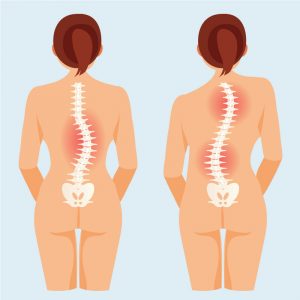
Most people think poor posture just means a sore neck or tight shoulders. But the reality? Bad posture side effects go far deeper than temporary discomfort. When your spine loses its natural alignment, it doesn’t just affect your back – it changes how your entire body functions.
At CorePosture Chiropractic, we see patients every week who are shocked to discover their headaches, fatigue, or breathing issues stem from postural problems they’ve had for years. The frustrating part? These issues develop gradually, so people adapt without realizing how much dysfunction has crept in.
Here’s what you need to understand: posture problems rarely fix themselves. In fact, they tend to worsen over time, creating a cascade of symptoms that seem completely unrelated. Let’s break down the five most common bad posture side effects and why they happen.
The 5 Most Common Bad Posture Side Effects
1. Chronic Neck, Shoulder and Back Pain
This one’s probably not surprising. Poor posture puts constant stress on muscles and joints that weren’t designed to handle it. When your head shifts forward or your shoulders round, specific muscle groups work overtime just to keep you upright.
The result? Muscle overload, joint irritation, and pain that keeps coming back no matter how much you stretch or exercise. Stretching might provide temporary relief, but it doesn’t address the underlying alignment problem.
Early warning signs include:
- Stiffness that worsens throughout the day
- Pain that improves with rest but returns quickly
- One-sided tightness or discomfort
- Difficulty finding a comfortable sleeping position
2. Headaches, Jaw Tension and Upper Neck Strain
Forward head posture doesn’t just hurt your neck – it triggers tension headaches. Here’s why: when your head shifts forward, the muscles at the base of your skull work constantly to prevent your head from falling further. This creates chronic muscle fatigue, nerve irritation, and reduced blood flow.
Many patients come to our chiropractor Newport Beach office complaining of frequent headaches, only to discover their posture is the primary culprit. They’ve tried medication, hydration, and stress management – but never addressed the mechanical cause.
According to Fernández-de-las-Peñas et al. (2006) in Cephalalgia, individuals with chronic tension-type headaches consistently demonstrate forward head posture and increased muscle tension compared to headache-free individuals.
Common symptoms include:
- Headaches that start at the base of the skull
- Jaw clenching or TMJ discomfort
- Neck stiffness upon waking
- Pain that intensifies with screen time
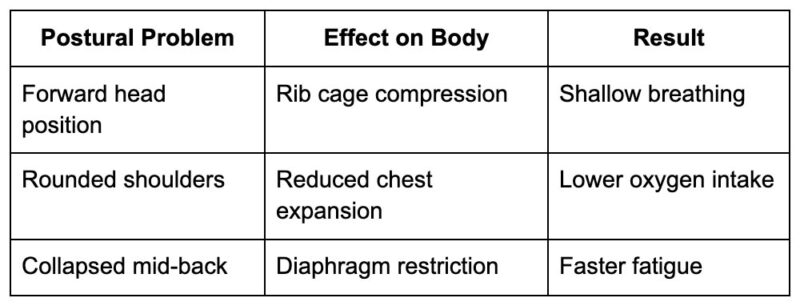
3. Reduced Breathing Capacity, Fatigue and Low Energy
This one surprises people. Slouched posture compresses your rib cage, which limits how deeply you can breathe. When your chest collapses forward, your diaphragm can’t expand fully. The outcome? Shallow breathing, decreased oxygen intake, and persistent fatigue.
We’ve had patients report better energy levels after correcting their posture – not because we gave them supplements or told them to sleep more, but simply because their body could finally breathe efficiently again.
How poor posture drains your energy:
4. Nervous System Interference and Reduced Coordination
Your spine isn’t just structural support – it protects your nervous system. When posture deteriorates, spinal misalignments can create nerve stress and interfere with the signals traveling between your brain and body.
This doesn’t always show up as pain. Sometimes it manifests as poor balance, slower reaction times, or subtle coordination issues. Athletes notice this first, but it affects everyone’s daily function.
Signs of nervous system interference:
- Balance issues or unsteadiness
- Decreased body awareness
- Reduced hand-eye coordination
- Muscle weakness without clear cause
5. Long-Term Spinal Degeneration and Loss of Mobility
Here’s the harsh truth: poor posture accelerates spinal aging. When your spine is misaligned, certain joints and discs experience uneven pressure. Over years and decades, this causes premature wear, disc degeneration, and loss of mobility.
Think of it like uneven tire wear on a car – when the alignment is off, everything breaks down faster. The same principle applies to your spine.
Progressive effects of poor posture:
- Initial muscle tension and discomfort
- Joint restriction and reduced range of motion
- Disc compression and early degeneration
- Bone spur formation and permanent changes
- Significant mobility loss and chronic pain
See more: Can Bad Posture Cause Scoliosis? The Truth You Need to Know
How Chiropractic BioPhysics (CBP) Addresses Bad Posture Side Effects
Most treatments focus on symptom relief – massage for tight muscles, medication for headaches, stretching for stiffness. But none of these address the root cause: structural misalignment.
CBP takes a different approach. Instead of chasing symptoms, we work to restore your spine’s natural curves and proper alignment. This improves how your body distributes load, reduces stress on joints and nerves, and allows your nervous system to function optimally.
What makes CBP different:
- Objective postural measurements and X-ray analysis
- Customized corrective protocols for each patient
- Mirror-image adjustments to restore ideal alignment
- Focus on long-term structural correction, not temporary relief
Patients often notice improvements beyond pain reduction. Better breathing. More energy. Easier movement. These aren’t random benefits – they’re the natural result of removing postural stress from your body.
Final Thoughts
Understanding bad posture side effects is the first step toward doing something about them. But here’s what matters most: posture isn’t just about looking better or sitting straighter. It’s about how your body ages, how well your nervous system functions, and how freely you move through life.
Small misalignments create widespread effects that accumulate over time. The headaches, fatigue, and pain you’re experiencing today are often the result of postural problems that started years ago. And without intervention, they’ll likely worsen.
Correcting posture improves more than comfort – it enhances function, prevents degeneration, and supports long-term health. Think of it as an investment in how you’ll feel and move 10, 20 or 30 years from now.
Ready to address the root cause of your symptoms? A professional postural assessment can identify exactly what’s happening with your spine and create a clear path toward correction. At CorePosture Chiropractic, we don’t just treat bad posture side effects – we help you build a healthier, more resilient spine for life.
Schedule your comprehensive posture evaluation today and start moving toward lasting relief.

Dr. Tyler Meier is a board-certified, licensed chiropractor and founder of CorePosture Chiropractic in Newport Beach, CA