Last Modified on March 30, 2026 by Dr. Tyler Meier
What Does a Pinched Nerve Feel Like? 6 Warning Signs You Shouldn’t Ignore

Understanding what does a pinched nerve feel like helps you recognize when you’re dealing with nerve compression rather than simple muscle strain. The difference matters because nerve issues require specific treatment and ignoring them can lead to permanent damage.
At CorePosture Chiropractic in Newport Beach, we specialize in identifying and correcting the structural causes of nerve compression. Let’s break down exactly what nerve pain feels like and why it demands immediate attention.
How Nerve Pain Differs from Muscle Pain
Is It a Dull Ache or an Electric Shock?
Muscle pain and nerve pain feel completely different – yet many people confuse them.
Muscle pain characteristics:
- Dull, achy sensation
- Localized to specific area
- Worsens with use of that muscle
- Improves with rest and stretching
- Responds well to heat/massage
Nerve pain characteristics:
- Sharp, electric, or burning quality
- Radiates beyond injury site
- May worsen with specific positions
- Doesn’t improve with typical muscle treatments
- Often includes tingling or numbness
If your pain shoots, burns, or creates “electric shock” sensations, you’re likely dealing with nerve compression, not muscle strain.
Why Pain Often Travels (The Referral Pattern)
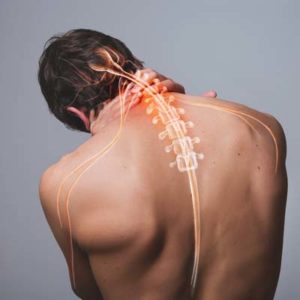
Nerves are like electrical wires running from your spine throughout your body. When a nerve gets compressed at the spine, you feel symptoms wherever that nerve travels – not just at the compression site.
Common referral patterns:
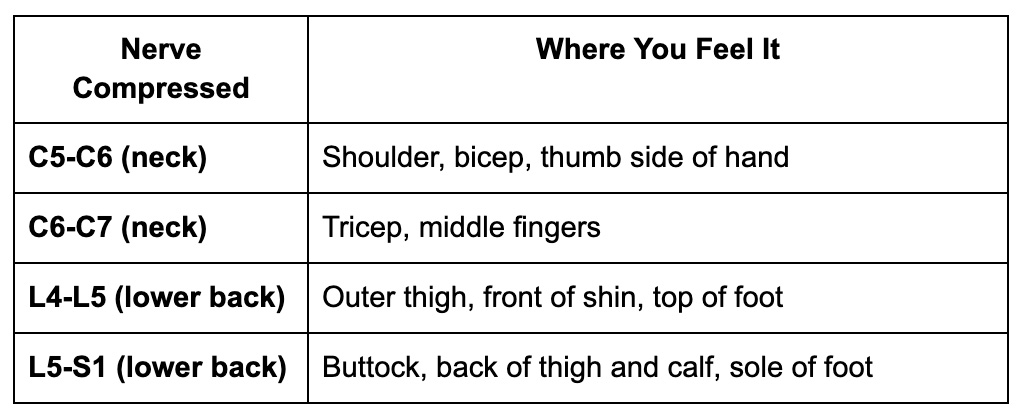
This is why you might have severe arm pain with no neck pain – or leg pain with minimal back discomfort. The nerve compression happens at the spine, but symptoms appear downstream.
6 Common Signs of a Pinched Nerve
1. “Pins and Needles” (Paresthesia)
That prickly, tingling sensation – like your limb “fell asleep” but won’t wake up. This is often the first sign of nerve compression.
What’s happening: Mild nerve irritation disrupts normal sensation signals. Your brain receives scrambled messages, creating that characteristic tingling feeling.
When to worry: If pins and needles last more than a few minutes or occur frequently, nerve compression is likely present.
2. Sharp, Electric, or Burning Pain
This is the hallmark of what does a pinched nerve feel like – sudden, shocking pain that takes your breath away.
Common descriptions patients use:
- “Like someone stuck a hot poker in my back”
- “Electric shocks shooting down my leg”
- “Burning sensation that never stops”
- “Lightning bolt pain with certain movements”
This pain often intensifies with specific positions – turning your head, bending forward, or reaching overhead – because these movements further compress the already irritated nerve.
3. Muscle Weakness
Nerves don’t just carry sensation – they control muscle function. When compressed, muscles served by that nerve become weak.
Examples of nerve-related weakness:
- Cervical (neck) nerve: Difficulty gripping objects, dropping things
- Lumbar (lower back) nerve: Foot drop, difficulty standing on toes
- Thoracic (mid-back) nerve: Core weakness, balance problems
4. Numbness or Loss of Sensation
Unlike tingling, true numbness means complete loss of feeling – like the nerve signal got completely blocked.
Testing for numbness:
- Touch the affected area with a finger
- Compare sensation to the opposite side
- Notice if you can feel light touch, pressure, temperature
Progressive numbness indicates worsening compression. The longer a nerve stays compressed, the more function it loses.
5. “Traveling” Pain
Sciatica is the most well-known example – lower back nerve compression creating pain that radiates through the buttock and down the leg, sometimes all the way to the foot.
Cervical (neck) nerve compression creates similar traveling pain patterns in the arm.
Classic traveling pain patterns:
- Pain starting at spine, radiating to extremity
- Worse with coughing, sneezing, or straining
- May worsen at night
- Changes with body position
This distribution pattern is the key differentiator between nerve pain and other conditions.
6. The “Heavy” Limb Feeling
Many people describe their affected arm or leg feeling “heavy” or “like it weighs 50 pounds”.
What causes this sensation: Disrupted nerve signals affect both sensation and muscle control, creating a feeling of heaviness even though the limb hasn’t changed weight.
This often accompanies weakness and indicates significant nerve involvement requiring professional assessment.
Chiropractic BioPhysics: Reshaping the Spine to Free the Nerve
Moving Beyond Temporary Relief
Understanding what does a pinched nerve feel like is step one. Step two is addressing the root cause not just masking symptoms.
Most treatments focus on pain management: medications, injections, muscle relaxers. These might reduce symptoms temporarily, but they don’t fix the structural problem compressing the nerve.
At our chiropractor Newport Beach practice, we use Chiropractic BioPhysics (CBP) to correct the spinal misalignments creating nerve compression.
Using Traction and Mirror-Image Adjustments to Restore “Nerve Room”
CBP isn’t general chiropractic – it’s structural correction specifically designed to reshape the spine and create space for compressed nerves.
CBP protocol for pinched nerves:
- Precise X-ray analysis: Identify exact location and degree of compression
- Mirror-image adjustments: Correct misalignments compressing nerves
- Specific traction: Reshape spinal curves to increase nerve space
- Targeted exercises: Reinforce corrections and prevent recurrence
Why this approach works:
- Addresses structural cause, not just symptoms
- Creates lasting space for nerve tissue
- Prevents future compression episodes
- Avoids medications and surgical intervention
Don’t Wait for Numbness to Become Permanent
Now that you know what does a pinched nerve feel like, don’t ignore the warning signs. Every day of nerve compression increases the risk of permanent damage.
At CorePosture Chiropractic, we specialize in identifying and correcting the structural causes of nerve compression using Chiropractic BioPhysics. We don’t just manage pain – we reshape your spine to free compressed nerves and prevent future problems.
Call CorePosture Chiropractic now or book online. Schedule a comprehensive structural evaluation today. We’ll perform detailed X-ray analysis, identify exactly where and why your nerve is compressed, and create a personalized correction plan to restore proper function.

Dr. Tyler Meier is a board-certified, licensed chiropractor and founder of CorePosture Chiropractic in Newport Beach, CA